Doing what we weren’t supposed to do in the RAF was one of my personal specialities.
Doing something that a helicopter couldn’t do was just crass stupidity.
There was nothing on the clock but the maker’s name.
It’s a euphemism for flying so low in an aircraft that the altimeter doesn’t register any height. The experience is pretty hairy if it’s planned, but if it isn’t planned then it’s the time that imminent destruction is calling.
There would have been nothing on the clock but the makers name if I had the wherewithal to look at it, but my world was a haze of brown and green as we hurtled past trees and bushes at root level, in a thrashing of noise and vibration.
I was in temporarily in that a world where everything slows down. An internal scream of “NOOOOOOOOO” shouted silently through my head, strangled by the shock and disbelief of an impending death through my own crass stupidity and downright overzealousness.
I had certainly over-cooked this manoeuvre.
As a junior pilot on my first squadron in the RAF, the previous four years had been a grinding process of mental challenge, tests, more tests, and struggle. But I had made it. Were it not for my children, I would have given up the effort long before and happily thrown in the towel in exchange for my old job as a television salesman. It didn’t pay much, but it was easier, and probably safer.
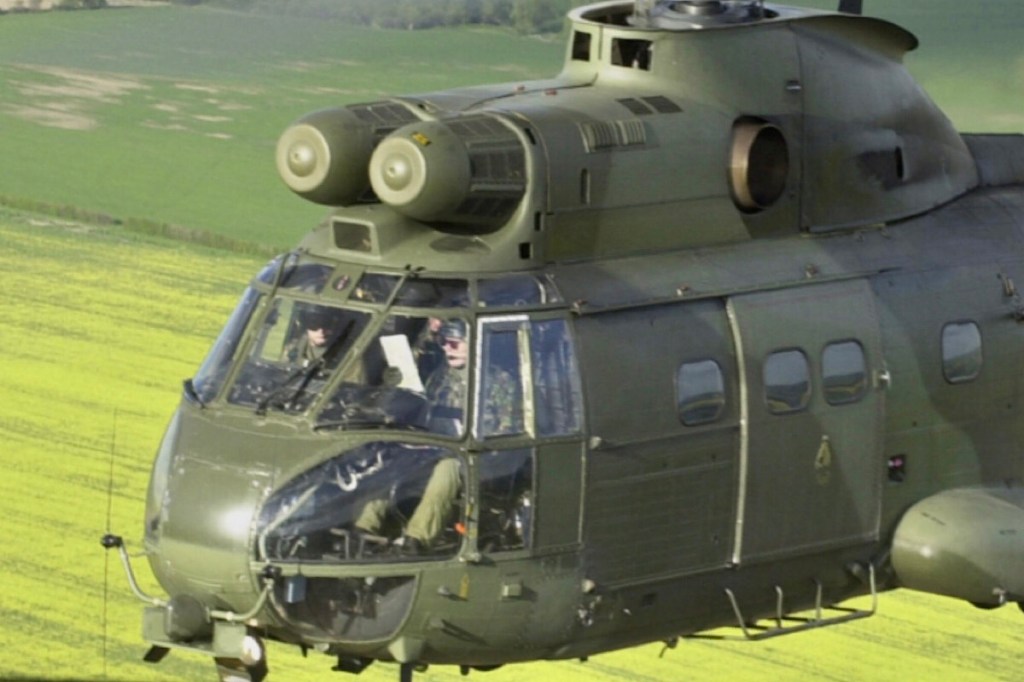
But I had made it, and for once the eyes of my superiors or instructors weren’t staring me down for being very, very average in my ability to command a multimillion-pound, twin jet engine, sixteen-seater Puma helicopter capable of almost 170 mph in a gentle dive.
Or maybe 200mph in a steep dive.
Maybe it is worth explaining that beyond such speeds, helicopter rotor blades start to do weird things. Blades on one side of the helicopter move incredibly fast, almost becoming supersonic, and on the other side they move towards nothingness, a stall in technical terms.
The whole kaboodle isn’t good for the rotor head or the hydraulics or anyone on board.
Young, junior pilots are known for their cocky approach. The whole pilot selection system is designed to find them, exploit them for their quick thinking, autonomy and bravery and , one hopes, good looks. The training system is designed to knock most of that stupidity out of them, keep the good looks, and produce safe, ultra-competent pilots capable of keeping a cool head when all hell lets loose in combat.
For both the pilot’s good health and the aircraft’s good health, there is something called the ‘flight envelope’, outside of which an aircraft isn’t designed to be operated. It holds data and technical limits such as maximum speed, maximum weight, maximum ceiling blah blah blah. A pilot is naturally required to respect this envelope otherwise it can have fatal consequences.
The phrase “There are old pilots and there are bold pilots, but there are no old, bold pilots” was heard on a weekly basis from the old soaks and the sages of the flight line.
The phrase “Fortune favours the bold” was also occasionally muttered by aspiring mavericks when the old grumps were out of earshot.
Plus, the training system isn’t foolproof though, of which I’m living proof. Many a hole has been dug in the ground by an aircraft fly by a bold, testosterone driven, renegade pilot who holds the DNA coding of a Darwinian adventurer, wanting to test and exceed the flight envelope in the pursuit of sheer joy and daring. It seems that my DNA was a little Darwinian too.
On this particular occasion I was of course outside the flight envelope, enticed in part by more experienced pilots than myself.
“You know, you can do a barrel roll in one of these.” I overheard at the bar one night. A discussion between an experienced pilot and senior crewman that I should have wholeheartedly ignored. There is absolutely no way a helicopter is designed to be halfway upside down let along totally upside down. Those things will destroy themselves in a mass of thrashing, tangled ironwork by the time a helicopter goes anywhere near inverted.
Unless of course it’s a barrel roll. Apparently. For the technical, this manoeuvre theoretically keeps a positive G on the aircraft structure at all times. Eager, naïve, curious, excited, bold, I quietly asked my informant “So how?” “How can you do one?”
“Well it starts with the wingover.” I was told as the more seasoned pilot described the manoeuvre “ But you have to start taking it further and further over until you are starting to get inverted.” His hands showed me the progression from flat to almost upside down. “The hard part is practicing it, because at first you can’t go all the way into the barrel roll; you have to ease yourself into it bit by bit to get a feel for it, and each time fly out of it the same way you went in.”
His hand did a “dodgy wobble” that didn’t give me any clues as to the recovery. In hindsight I should have taken note of that bit. You can’t do a dodgy wobble. It doesn’t exist in any aerobatics workbook because, well, it just doesn’t exist. He was bluffing. And I failed to ask the specific question that would have revealed essential lifesaving information which was “Have YOU ever done one?”. Silly me.
Undeterred I spent so many nights wondering if I had the courage AND the skill to start experimenting, if it had indeed been down before, and also wondering just how I could hide my thrill-seeking desires without my superiors noticing.
The solution came in General Handling flying sessions. Each month we had to do at least an hour of fun flying training at the sole expense of Her Majesty. Just a pilot and a crewman, no passengers. General Handling was just really licensed fun and frolics, ensuring that all the fine handling skills were up to date and still available to ensure that a pilot could execute emergencies procedures and rapid escape manoeuvres with aplomb and finesse. Some took it seriously. Some, especially junior pilots like myself, just released into the wild, soon discovered the joy of freedom out of the sights of mummy and daddy.
Imagine a penniless twenty something having a toy the price of twenty brand new Ferraris, with infinitely more power than twenty Ferraris, that could go almost anywhere, land on mountains or sea, fly at speed below treetops or above the clouds, day or night. It was licensed hooliganism and the keys were handed over to a new pilot with a pretty much a free reign. And for me, that included examining the possibility of the unmentionable “barrel roll”.
Sure enough, I had worked out that the start of a barrel roll starts with a “wingover”. It’s like a handbrake turn in the sky, frankly terrifying for passengers to watch, designed to allow a rapid change in direction. The helicopter points straight up into the sky, loses all speed, whips round and blasts back down to earth again. In hostile territory a helicopter can approach a drop-off zone at high speed, do the wingover thing and land very quickly.
I loved practising wingovers. They became easy. It was the closest to bonkers that I could get apart from ultra-low level flying or dodging bullets. And my crewmen didn’t seem to be worried by the crazy guy behind the stick either. In fact some liked it too much.
I would often give them a chance of flying when no-one else was looking, when they came with the excuse “If you got shot Sir, I need to know that I could fly the aircraft for you”. Some loved it more than others and Kenny Mclaughlin was one of those crewmen. A Scot with a dry sense of humour and a joy that he had been able to progress into becoming aircrew.
Whilst flying sensibly with him, I sometimes felt my collective stick getting pushed upwards, urging the aircraft to go faster. It was Kenny, reaching from the cabin or sat in the co-pilots seat, pushing it up, wanting a more dynamic flying, encouraging me to explore the flight envelope with more inspiration than was currently in vogue.
On the day in question, it was a nice summer day, with a light wind and clear blue skies. Kenny and I had been playing around doing whatever we were supposed to do for General Handling. It came to another opportunity for me to try the barrel roll; I had been practicing getting closer a few months, going further and further, each time into the uncharted territory outside the flight envelope.
The average, standard, maximum angle of roll would be 70 to 80 degrees for a textbook wingover. I had to go much, much further than that if I wanted to do a successful barrel roll, or even practice getting close to it. I pushed it to 85, then 90, then 95, then 100, then 105, then 110. By this time the view of the world was decidedly weird and upside down. Things happened fast in this zone and keeping an eye on how much roll I had taken the helicopter over to wasn’t the easiest. The rollouts became more and more aggressive as increasing forces ripped through the aircraft whilst trying to bring it back to straight and level again, and in one piece.
I was undeterred, feeling invincible, pushing further into the unknown, but feeling very much alive. Kenny was up for a challenge too. But on my last ever run to do a barrel roll with Kenny as my crewman, I overcooked it, and pushed the aircraft beyond its limits and ended up in something called “jackstall”.
Crewroom chats were a daily routine and the banter included all sorts of stories, near misses and daredo stuff, but there was the sometimes discussion on technical stuff. One such subject was about a design limitation of French helicopters known as “Jackstall”. It was all theoretical stuff and not many had experienced it for real and lived to tell the story. The event was never shown or practiced during any training, ever. I didn’t pay a huge amount of attention to it anyway. Maybe I should have.
Decades after the event, I did some research to understanding it more. Under severe manoeuvring, the forces on the rotor blades overcome the ability of their hydraulic jacks to control them and the pilots flying controls lock up, with nasty consequences; sometimes the controls lock up for a few seconds, for many seconds, or forever. In a steep descending manoeuvre this lock up has been known to go on, in a nosedive, for an incredible 1500 feet before recovery.
That knowledge, with hindsight, is quite terrifying.
On the day in question I knew I wanted lots of height in case it got a bit hairy, so I started my run in at 800 feet in a gentle dive to build up the maximum speed before starting the pull up.
I had no idea how hairy it was going to get and I didn’t know that really I should be aiming for 2,000 feet or more.
In the dive, approaching 500 feet at max speed I pulled up firmly and smoothly, but not too hard and with full power. The aircraft climbed rapidly and soon reached the vertical nose up position.
At the top, zero G approached, I pushed down on the collective, reducing power and rolled to allow weightlessness and a little rudder to pull us over, aiming for 110 or 115 degrees, the furthest ever, and well into upside down
But I was only at around 1000 feet. Not the minimum 2000 ft I’d need if the unbeknown jackstall hit.
I quickly started introducing roll watching it rapidly go from 0 through 90 and 100 beyond. Starting to become upside down. Enough was enough for this attempt though, I knew I had to be smooth, but decisive and really feel through my body how the whole manoeuvre was going.
I had a thousand feet to play with. Bearing in mind that a wingover can be done safely in under two or three hundred feet, this gave me a huge margin, unless, of course the untamed, untrained and unexpected jackstall kicked in.
The aircraft shuddered as I pulled over the top and tried to smoothly correct the pitch and roll. I didn’t know until years later that the direction I was doing this in (rapid turning right) induced forces that quickly allowed Jackstall to occur. Hindsight is a great thing.
Over the top we went as though we were on a Disney Air-Ride, the pull continued as we went from upside down to nose straight down. Speed was rapidly coming on and the G forces racking up, who knows to what level.
An instructor later reported in an online forum “The loads that must be imposed on the airframe in carrying out jackstall would be large. I can’t see it happening with much less than 3.5 – 4 g.” That’s a LOT for a helicopter. It makes sense though as I was pulling harder than ever on the controls, encouraging the beast to pull out of the dive and try and stay within the flight envelope.
I obviously didn’t succeed as Jackstall hit, not that I knew it at the time. But Jackstall hit in all its hideous glory took over our lives.
This was, in retrospect, the reincarnation of the “Dodgy Wobble”. It made perfect sense forty years after the event. The “Dodgy Wobble” with its associated hand movements, really means “I can’t explain it, but it all goes to ratshit. Work it out yourself what follows, because I don’t know, you’ll probably die”.
In the crazy dive we were right in “Dodgy Wobble” territory and my controls froze up on me at the exact time when I so needed pull this helicopter out of its death dive. I was robbed of all control and I was powerless to fly this beast; nothing worked no matter how hard I pulled or pushed.
We probably had only seven seconds before we hit the ground nose first and became another smoking statistic of “Pilot error”.
On the way down my eyes popped so wide open so that I could take in every bit of available information, but I mostly saw the green of the fields below and ahead of me, then my gloved hands achieving nothing, then the green, then my hands again.
I was soon aware that no matter what I did with the controls, the aircraft wasn’t responding to my inputs. And the green, green, ground ahead was coming up incredibly fast.
Confusion, disbelief and then my life zipped through me in the space of a couple of seconds.
Outside the cockpit everything was still green but getting closer. We were heading straight down. To this day I can still see the image; an empty agricultural field to the South of Odiham, used for grazing livestock, with fir and some oak or beech trees around it. A farmhouse to the north of the field, more fields in the distance with minor roads to my right, a major road, the A31 to the left in the distance. Cars and a lorry on it. Like a google maps image of the countryside, this was akin to zooming into an online map as fast as possible.
My hands were still trying to move the controls. My head was checking that my hands were doing the right things. They were. Nothing. The cyclic was dead, the collective had no effect. Nothing. I knew for sure that something was incredibly wrong. I fought with the controls as the ground raced up towards us. The machine was on rocket assist aiming to bury straight into the patch of ground beside the farmhouse that I was looking at. Maybe six hundred feet had been lost since the apex, a rollout to straight and level would need three hundred feet at least.
To this day I don’t know why it happened not a split second later; it was simply the difference between walking away completely unscathed and instant death. But control response came back and I was able to pull the stick into my stomach and raise the collective. I pulled and pulled and pulled . The “WOKKA WOKKA” of rotor blades on the verge of destruction must have been heard for miles. The rollout pulled us closer and closer to the ground and I had no idea if we would actually impact or not.
Eyes wide, getting pushed into our seats by massive G forces, we rounded out. The trees were no longer in front of me, they were beside me, then above me, everywhere. I was in the middle of them, dodging them left and right. They passed by so fast. Fir trees to the left and oaks to the right. A pig sty too. I could see the old furrows in the field just below the aircraft. We passed the farmhouse below roof level what must have been nearly 200mph narrowly missed a fence and shot up back up into space and climbed away to safety.
By her luck we escaped so unbelievably close to being half a mile of burning wreckage.
As you would expect, that one scared the shit out of me and I gave up attempting the probably unachievable barrel roll. Kenny and I didn’t say much as we returned home, hoping that no-one would report us. We eventually looked at each other with that expression that simply said “Oops!”.
I have never since heard of anyone managing a barrel roll in a Puma. Maybe the “Dodgy Wobble” should have made it into the instruction manual as a deterrent to all would be adventurers of the sky.
But I can guarantee you won’t find it.


 Love is an Action
Leave a reply to Fynesy Cancel reply